
Advanced Rehabilitation for Dogs and Cats in Indianapolis
Pet rehabilitation can help dogs and cats recover from injury or surgery, manage changes in mobility, and regain strength after periods of limited activity. At Velocity Vet, we build individualized rehabilitation plans around each patient’s condition, abilities, comfort, and goals.
Some pets come to us after an orthopedic or neurologic procedure. Others need help managing arthritis, muscle loss, altered movement, or a longstanding injury. Rehabilitation may also support active pets that need a careful return to exercise. By combining hands-on care, therapeutic movement, and advanced technology, we help each patient work toward safer, more comfortable function.
A Rehabilitation Plan Built for Your Pet
No single treatment is right for every patient. We begin by evaluating how your pet stands, walks, shifts weight, and moves through daily activities. From there, we may combine several therapies within one coordinated plan.
Gait Analysis and Gait Training
Gait analysis helps our team study how a pet moves and identify changes such as limping, uneven weight distribution, shortened steps, or compensatory movement. These findings help guide treatment and give us a way to monitor progress over time.
Gait training then uses controlled movement and purposeful exercises to encourage safer, more efficient movement patterns.
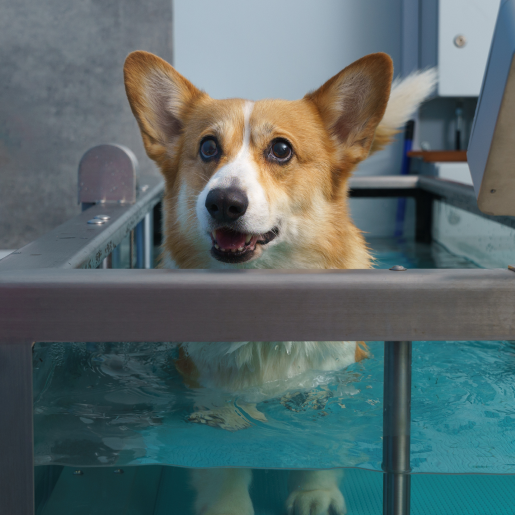
Underwater Treadmill Therapy
An underwater treadmill uses the natural properties of water to support the body while providing resistance. Buoyancy reduces the amount of weight placed on painful or healing joints, while the resistance of the water encourages muscle activity.
This controlled environment can support post-surgical recovery, neurologic rehabilitation, conditioning, weight management, and progressive strength building.
Therapeutic Land Exercises
Land-based exercises help pets practice movements they use in everyday life. Depending on the patient, a session may involve balance work, controlled walking, weight shifting, poles, platforms, or other equipment.
Exercises are selected to address specific needs, such as coordination, flexibility, core stability, endurance, or muscle development. As your pet progresses, the plan can be adjusted to introduce new challenges safely.
Laser Therapy
Laser therapy uses focused light energy to support cellular activity within targeted tissues. It may be incorporated into a rehabilitation plan to help manage discomfort, encourage circulation, and support healing in muscles, joints, or other soft tissues.
Because laser therapy is noninvasive, many pets remain comfortable and relaxed during treatment.
Pulsed Electromagnetic Field Therapy
Pulsed electromagnetic field therapy, often called PEMF, applies controlled electromagnetic pulses to a targeted area. It may be used as part of a broader rehabilitation plan for pets experiencing discomfort, inflammation, or delayed tissue recovery.
Our team determines whether PEMF is appropriate based on the patient’s condition and overall treatment goals.
Shockwave Therapy
Shockwave therapy delivers focused acoustic energy to an injured or painful area. In veterinary rehabilitation, it may be considered for certain tendon, ligament, muscle, bone, or joint conditions.
Treatment recommendations depend on the location and nature of the problem. Shockwave therapy is generally combined with therapeutic exercise or other rehabilitation methods rather than used as a stand-alone solution.
Therapeutic Ultrasound
Therapeutic ultrasound uses sound waves to deliver energy into deeper tissues. It may help increase circulation, improve tissue flexibility, and support the management of muscle or tendon injuries and restricted range of motion.
Therapeutic ultrasound is different from diagnostic ultrasound. One supports treatment, while the other creates images that help us evaluate tissues.
Electrical Stimulation
Velocity Vet offers both neuromuscular electrical stimulation and transcutaneous electrical nerve stimulation.
Neuromuscular electrical stimulation, or NMES, produces controlled muscle contractions. It may help activate weakened muscles, limit muscle loss, and support recovery after orthopedic or neurologic injury.
Transcutaneous electrical nerve stimulation, or TENS, is used primarily to support pain management by delivering a low-level electrical current to a targeted area.
Dry Needling and Trigger Point Therapy
Tight bands of muscle and sensitive trigger points can contribute to discomfort and limited movement. Dry needling and trigger point therapy target these areas to encourage relaxation and improve muscle function.
These techniques are used selectively and only when they suit the patient’s diagnosis, tolerance, and rehabilitation plan.
Massage and Hands-On Therapy
Veterinary massage can help reduce muscle tension, promote circulation, and improve comfort. Hands-on techniques also allow our team to assess tissue quality, areas of sensitivity, and changes in flexibility from one visit to the next.
Massage may be paired with stretching, joint movement, therapeutic exercise, or other treatments.
Imaging That Supports Rehabilitation
A clear understanding of the underlying problem helps us build a more focused plan. Velocity Vet offers musculoskeletal ultrasound and orthopedic X-rays as part of its rehabilitation capabilities.
Musculoskeletal Ultrasound
Musculoskeletal ultrasound allows us to examine certain muscles, tendons, ligaments, and surrounding soft tissues in real time. It may help guide evaluation, treatment planning, and follow-up assessments.
Orthopedic X-Rays
Orthopedic X-rays provide images of bones and joints. They may help us evaluate alignment, arthritis, fractures, healing, or other structural concerns that can affect movement.
Helping Pets Make Meaningful Progress
Rehabilitation is rarely about one treatment or one appointment. Progress often comes from combining appropriate therapies, gradually increasing activity, and adjusting the plan as the patient changes.
Velocity Vet also offers dedicated pain management and conditioning and exercise services when a pet’s needs extend beyond rehabilitation alone. Together, we’ll focus on practical goals that support movement, confidence, and quality of life.